
What a Green Resident Lookup Can Confirm
No single result proves every detail about a person. This Green resident lookup coverage map separates the question asked from the type of record that can answer it. Start with the least intrusive official route that fits the known fact, and treat a nonmatch as an unresolved lead rather than a conclusion.
| Record | What It Confirms | Where | Access |
|---|---|---|---|
| Property and tax roll | Current owner field, parcel, situs, and tax mailing field | Summit County Fiscal Office Property Tax Information | Public current tax-year search; live data can change |
| Recorded documents | Named grantor or grantee and document chain | Fiscal Office Recording Division | Web records from 1988; IBAV for 1840–1988 |
| Voter record | Publicly available elector and precinct information | Ohio My Voter Information and Summit BOE tools | Statutory redactions and confidential records apply |
| Court docket | Party, case category, docket events, and accessible filings | Barberton, Common Pleas, Clerk, or Probate | Jurisdiction, court rule, and record restriction control |
| Marriage or Probate record | Legal event, estate, or guardianship context | Summit County Probate Court | Index, request, and certified-copy routes differ |
| Birth or death record | Recorded vital event | SCPH, Ohio Department of Health, or historic Probate holding | Signed application and statutory limitations |
| Business, UCC, or credential filing | Public affiliation or credential status | Ohio SOS, UCC portal, or eLicense | Not proof of current residence or identity |
A known name and a dated address are often enough to choose a first source. If the question is only whether a named person owns a particular parcel, begin with the Fiscal Office. If it concerns a case, estate, marriage, or historic vital event, go to the court or registrar that has custody instead of using a general people-search claim.
Green Records Need Two Facts
Common surnames, initials, former names, shared addresses, limited-liability ownership, and a mismatch between a property’s situs and tax mailing field can produce a false match. Capture a candidate name exactly as it appears, then compare two independent attributes. Useful combinations include a parcel and legal description, court date and party role, voter precinct where legally displayed, a spouse or occupation printed in a historical directory, or parties on a recorded deed.
Green’s postal geography adds another warning: a postal locality label does not prove municipal jurisdiction. Keep the street number, parcel, or jurisdiction fact with the result. When the goal changes from a specific person to a present-day address trail, use the Green by-street directory for the parcel and map workflow rather than expanding a name search beyond its purpose.
Green Resident Lookup Owner Search
The Summit County Fiscal Office Property Tax Information page is an owner and address entry point, not a title certificate. Select the tax year first. Owner mode uses Lastname%Firstname%, such as Smith%John%, or a surname alone. Address mode uses a number and street, such as 123 main, and instructs users to omit direction and suffix. Parcel, route, and image-parcel search modes are also documented.
A resulting parcel card can include parcel ID, tax year, owner name, owner or mailing data, property or situs address, legal and parcel data, appraisal and assessment, sales, tax-claim information, and sometimes permit or dwelling details. Record which field supplied the clue. The mailing field is for tax correspondence and can differ from the property address, so it is not a household roster or proof that the named person lives there.
Green Resident Lookup Court Records
Green municipal matters follow a different court route from county and estate matters. Barberton Municipal Court handles Green traffic and criminal matters, small claims, and limited civil actions. Summit County Common Pleas and the Clerk systems cover matters such as felony criminal cases, major civil cases, foreclosure, appeals, and domestic-relations records. Probate is independent and is the appropriate route for estates, guardianships, marriages, and certain historic vital material.
The Common Pleas General Division Case Search by Name requires at least three letters of a first and last name, or a company name. Its documented fields are First Name, Middle Initial, Last Name, Company Name, and case type choices for All, Criminal, or Civil. Use a result and case number to continue to the Clerk’s official file or docket route. The Clerk recommends online records from 2002 onward and directs pre-2002 research to a Public Records Form by email, mail, or in person.
For Green municipal matters, Barberton CaseLook is the official entry point. The Court recommends online access for 1996 to the present; earlier records require a written request by email, mail, or in person. Its entry page links Record Search, Hearing Calendar, Warrant List, and Probation Search, but the individual search controls were not fully captured, so no additional field labels should be assumed.
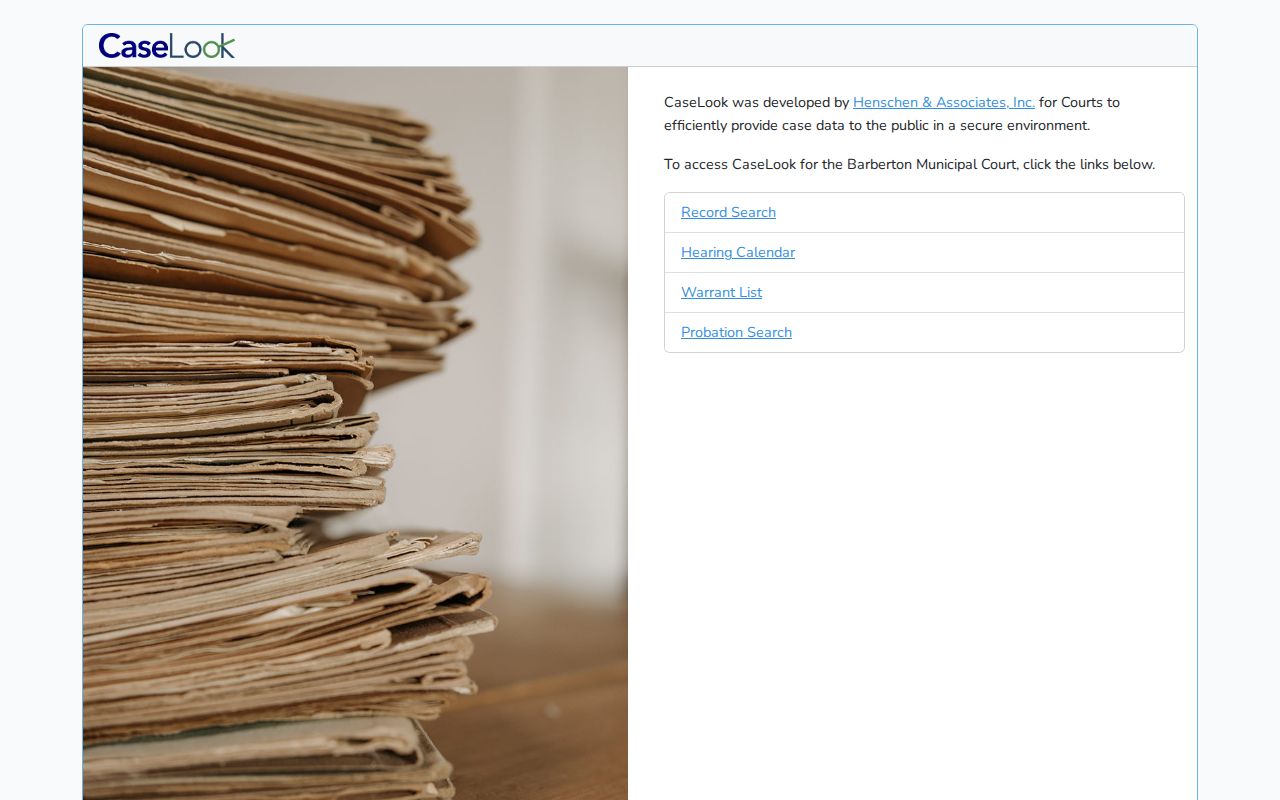
The CaseLook screen is only one part of a court-by-court plan. A same-name result must be checked against jurisdiction, party role, case date, and the court’s own access rules. Sealed, expunged, juvenile, adoption, protected domestic, and other restricted material should never be presumed available.
Verifying a Green Resident Through Custodian Records
A resident lookup becomes more reliable when its steps are recorded in order. This workflow is for testing a candidate against official records, not for constructing a profile from unrelated details.
- Write the candidate name exactly as found, including initials or former surname clues, and record the date of the result.
- Search the Fiscal Office using the selected tax year and
Lastname%Firstname%owner format. Separate the parcel’s situs, legal description, and mailing field. - Choose the court with subject-matter jurisdiction. Run the Common Pleas name search with lawful variants, or use Barberton for the municipal category, then compare case date and party role.
- For an estate or marriage question, use Summit Probate’s separate CASE or historical request route; for a vital event, choose the registrar or historic custodian for the event and era.
- Compare the two independent facts. If they conflict, retain the conflict and ask the record custodian about the correct record rather than forcing a match.
- Docket
- The court’s chronological case record. It can identify parties, case events, and disposition information where access is allowed; it is not an identity certificate.
- Index versus image
- An index points to a record through a name, date, case number, or document reference. An image is a view of the underlying page or filing. Availability and redactions differ by custodian.
- Certified copy
- A copy issued by the office that keeps the record for a formal purpose. It differs from a research index, web screen, or ordinary photocopy and follows the custodian’s current request rules.
Green Vital Record Routes
For Green-related events, first decide whether the need is a research lead, a historical index, or a certified record. Summit County Public Health issues certified birth copies for all Ohio counties and certified death copies for deaths in Summit County. Its inspected application lists $22 per certified copy. The state mail form has different listed fees, including $21.50 for a certified birth or death copy, so confirm the current charge with the office issuing the record.
Ohio Revised Code 3705.23 requires a signed application and fee for a certified vital copy unless a listed provision makes a record nonpublic. That is not a blanket age-based closure rule. Medical and health portions of a birth record, adoption-related records, and SSN-inclusive death requests have separate restrictions. Do not promise an arbitrary waiting period or a universal ID requirement that the inspected local application does not state.
Summit Probate holds historic births and deaths from 1869–1908 and marriage records from 1840. For marriages from 1840–1980, its research route asks for both surnames and the year; later records have a CASE route. The Akron Beacon Journal obituary indexes and the Ohio History Connection death research resources are leads to be checked, not replacements for a custodian-issued record.
Green Voter Record Limits
Ohio My Voter Information is a public verification tool, not an open-ended directory. Its guidance suggests trying name derivatives, former surnames, and a previous Ohio county address when an expected result is not found. Summit’s advanced tool hub also offers Voter Lookup, report-generation options, and Street Report Generation, but its live filters and disclaimer should be read in the official tool.
R.C. 3503.13 excludes Social Security numbers, driver or state ID numbers, telephone numbers, email addresses, confidential voter data, protected addresses, citizenship proof, and other legally prohibited information. A missing current result is not proof that a person never lived in Green: cancelled registrations are retained for a defined period and can result from many events. Preserve privacy limits instead of treating a public record’s absence as an invitation to search around them.
Green Affiliation Records
The Ohio Secretary of State Business Search can show public entity and statutory-agent information, but the Secretary of State says it does not maintain owner or officer lists. A statutory agent address is a required business or street address, not proof that the agent owns an entity or lives at that address. Use entity name, number, filing date, status, and agent data as the limited filing facts they are.
eLicense Ohio is a public credential route where the user selects a board and searches an individual by last name plus first initial or by credential number. A result can show status, board, type, number, dates, city or state, endorsements, and board-action indicator. The city or state shown may be business or correspondence information. UCC filings likewise identify financing-statement parties and dates, not an everyday residential location.
Green Protected Record Limits
Ohio Safe at Home can protect the address, phone, and identifying details of eligible participants through a substitute-address program. Protected voter records and, with the proper steps, later-acquired real-property records may not appear in normal public datasets. A resident lookup must never be used to discover a confidential address or to draw an adverse conclusion from a protected record’s absence.
Other limits are practical too. The Recorder redacts personal information on online document images and does not make military discharge records viewable online. Voter law excludes protected categories, and R.C. 149.45 permits qualifying officials and public-service workers to request online address redaction. A correction must go to the custodian: the Fiscal Office for property or mailing fields, the Board of Elections for registration, the Clerk or Court for docket procedures, SCPH or ODH for vital amendment instructions, and the Secretary of State or eLicense for filing or credential errors.
Lawful Boundaries for a Green Resident Lookup
Use records for a specific, lawful question such as family history, a property-history question, consent-based reconnection, or civic verification. The Ohio Public Records Act, R.C. 149.43, supports prompt inspection of existing public records and copies within a reasonable period, but it does not require an office to create a new resident list or conduct research. Send a focused request to the office that actually holds the record when an online path ends.
Lawful use. Use a Green resident lookup for personal, lawful research and respect every confidentiality program, redaction, court order, and custodian restriction. Do not use information to stalk, harass, intimidate, or harm anyone.